Evelyn Moore
Technical Writing & Training Content QA
Designing scalable training frameworks and ensuring quality, consistency, and instructional integrity across global learning programs.
What I Do & What I Deliver
What I Do
I bridge instructional design, technical editing, and process optimization—transforming complex workflows into clear, user-friendly documentation.
- Design clarity: Translating complex instructional and technical requirements into usable, learner-focused content.
- Operational structure: Creating standards, templates, and workflows that help teams work faster and more consistently.
What I Deliver
- Unified voice: Deliverables that align with brand and industry writing standards.
- Faster cycles: Development processes that are more predictable, efficient, and easier to maintain.
- Clear logic: Lessons that are instructionally sound and aligned to real job performance.
How I Approach Quality
Speak with One Voice
Every course should read as if written by a single expert, regardless of how many authors contribute.
- Standardized style guides and templates
- Editorial review for clarity, flow, and tone
Unified voice reduces rework and strengthens the learner experience.
Govern by Standards
Training decisions are anchored in defined instructional, technical, and accessibility standards.
- Taxonomy-based objectives aligned to measurable performance outcomes
- Technical and accessibility compliance across platforms and delivery formats
Standards ensure consistency, clarity, and instructional precision.
Tie Training to Real Job Tasks
Learning experiences must translate directly to on-the-job performance.
- Performance-aligned objectives grounded in real-world workplace behaviors
- Authentic scenarios and assessments that reflect job complexity
When training reflects the real job, learners gain skills that transfer immediately to their work.
Use AI as a Precision Tool
AI supports consistency, scale, and accuracy when applied with clear guardrails.
- Structured prompts and inputs to ensure predictable, usable outputs
- Alignment and terminology checks to maintain content integrity
AI is a partner for accuracy, not a substitute for the author's expertise.
Step-by-Step Planning
Create the Training Story
Establish the information strategy and define the training story.
- Who is the learner? Role, prior knowledge, constraints
- What does the learner need to know or do? Skills, tasks, decisions, standards
- Why does it matter? Risk, impact, compliance, performance
- Where and when will the learner use this? Real job context and scenarios
- How will we know they learned it? Practice-based checks tied to outcomes
Design the Course Architecture
Build the course structure, standards, and content framework.
- Analyze source materials to identify gaps, paths, and constraints
- Define objectives and standards that are measurable and performance-aligned
- Validate with Subject Matter Experts (SMEs) for accuracy and business relevance
- Build the course Training Plan as the course blueprint (scope, outline, assessment strategy)
Use AI-assisted refinement selectively to validate topic coverage, sequencing, and clarity — never as a replacement for instructional judgment.
Develop the Content
Write, refine, and validate content using instructional expertise and AI-assisted precision.
- Draft content aligned to objectives and the Training Plan
- Use structured AI checks for alignment, organization, and terminology
- Build assessments and knowledge checks that map to the enabling objectives
- Apply editorial + accessibility + QA review across formats before publish
Work Examples: Tools and Methodologies
The following work examples demonstrate the tools, methods, and proprietary systems I use to establish structure, consistency, and clarity across training programs.
Performance-based Training Blueprint
A structured system for aligning, planning, and standardizing performance-driven training.
This work sample demonstrates a two-part framework used to align stakeholders and define training before development begins. It guides instructional designers, subject matter experts, and business stakeholders through a structured working session to capture how work is actually performed, where breakdowns occur, and what successful performance looks like in real-world conditions.
By establishing a shared understanding upfront, this approach prevents misaligned objectives, reduces rework, and ensures training is directly tied to on-the-job performance. It also introduces standardized templates and planning tools that create consistency across course design, development, and delivery.
Framework overview
Training Blueprint
→ View the Performance-based Training Blueprint (PDF)
Defines the full system for performance-based training design, including alignment between business goals, job performance, and instructional structure.
Training Story
→ View the Training Story template (PDF)
Facilitates a structured discovery process that captures how work is actually performed, where breakdowns occur, and what success looks like in practice.
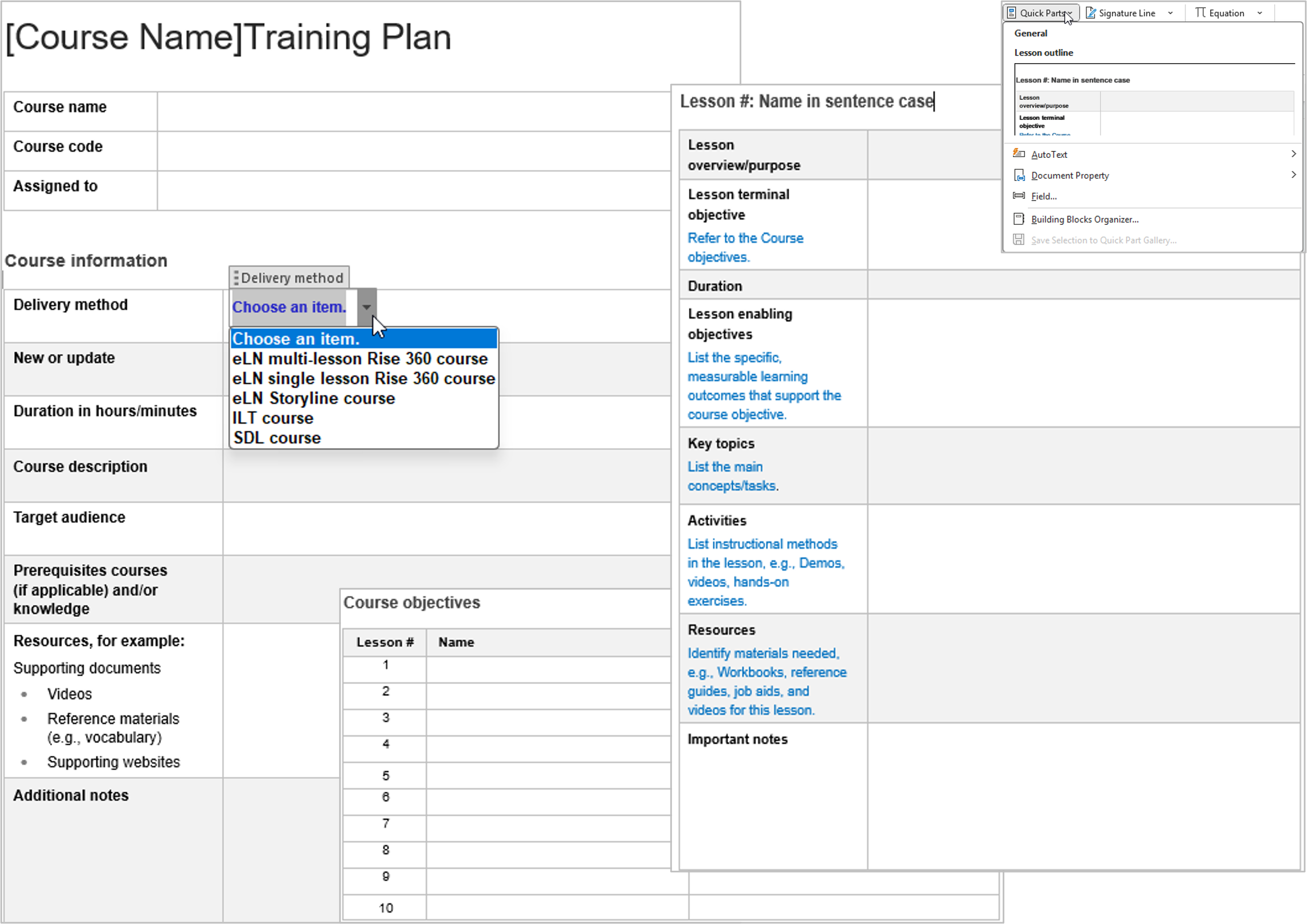
Training Plan
→ View the Training Plan template (PDF)
The Training Story directly informs the Training Plan — ensuring that what happens in the classroom translates to success on the job. This document standardizes how performance needs are translated into structured, objective-driven instruction.
Standardizes how performance is translated into objectives, lesson flow, and delivery guidance through:
- Course information and logistics
- Course objectives and lesson mapping
- Lesson outline structure (Quick Parts)
- Activities, resources, and delivery guidance
Writing Behavioral Objectives — Measurable, Aligned, and Performance-focused
This framework utilizes Bloom's Taxonomy to ensure clear, measurable objectives are defined at both the course and lesson levels.
Terminal Learning Objectives (TLOs)
TLOs define the overarching goal of a lesson, and are designed to:
- Represent the main performance outcome learners must achieve.
- Roll up to the course-level goals.
- Use one strong behavioral verb aligned with Bloom’s Taxonomy.
Enabling Learning Objectives (ELOs)
ELOs break down each TLO into smaller, measurable tasks, and must:
- Support the exact skills needed to meet the TLO.
- Drive the structure of content and assessments.
- Also follow the single-verb, single-task rule.
Why This Structure Matters
Both TLOs and ELOs:
- Must be observable and measurable.
- Use only one behavioral verb.
- Define a single, clear task.
- Include a purpose or outcome introduced with a preposition (to, for, by).
- Support the assessment strategy—how we will know the learner gained the skill.
Bloom’s Taxonomy serves as the guiding framework to match each objective to the level of thinking, learning, and understanding required.
| Step-by-Step | Guidance & Examples |
|---|---|
|
Start with an Action Stem
Clearly define the goal. |
After completing this course, you will be able to… At the end of this lesson, you will be able to… |
|
Choose a Measurable Verb
Use a single, observable action (based on Bloom's Taxomy). |
Explain, List, Maintain, Configure, Set Up, Describe, Summarize, Classify, Implement, Solve, Compare, Generate |
|
Define the Learning Task
Specify what the learner will do. |
… explain the features of the business unit module … … list the steps in the data extraction process … … maintain server log files … |
|
State the Purpose or Outcome
Use a preposition or a prepositional phrase to clarify intent. |
… explain the features of the business unit module to create an independent shipping warehouse “…to create an independent shipping warehouse.”
… list the steps in the data extraction process in preparation for running the monthly reports “…in preparation for running the monthly reports.”
… maintain server log files by ensuring the timely reporting of weekly staffing reports “…by ensuring the timely reporting of weekly staffing reports.”
|
AI-Assisted Design — Structured Markdown Prompts
Reusable prompts that speed up objective writing and knowledge-check creation while protecting instructional standards.
Markdown prompts help instructional designers maintain consistency and alignment in projects. They can be used to create course outlines, learning objectives, assessments, and ensure precise wording. The following examples demonstrate how to guide AI tools for consistent outputs when writing or revising objectives or creating knowledge checks.
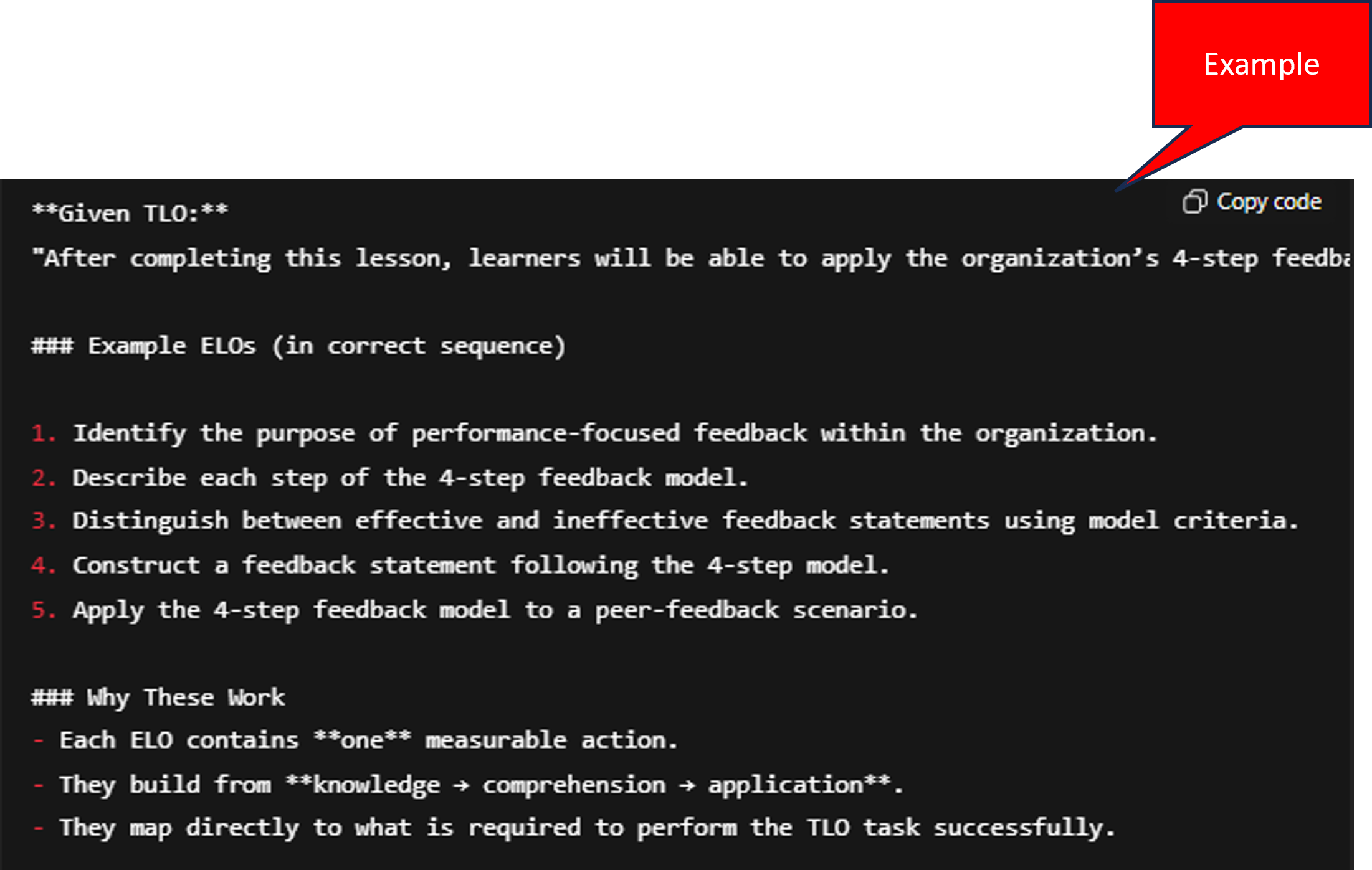
Prompt 1 — Create Enabling Learning Objectives from a TLO
Create a set of enabling learning objectives (ELOs) that represent the knowledge and skills required to achieve the following TLO.

TLO:
[paste terminal learning objective here]

Requirements:
• Align to Bloom’s Taxonomy (use measurable verbs).
• Write each ELO as a single-verb, single-task objective.
• Keep language clear, observable, and instructionally sound.
• Use parallel construction across the set.
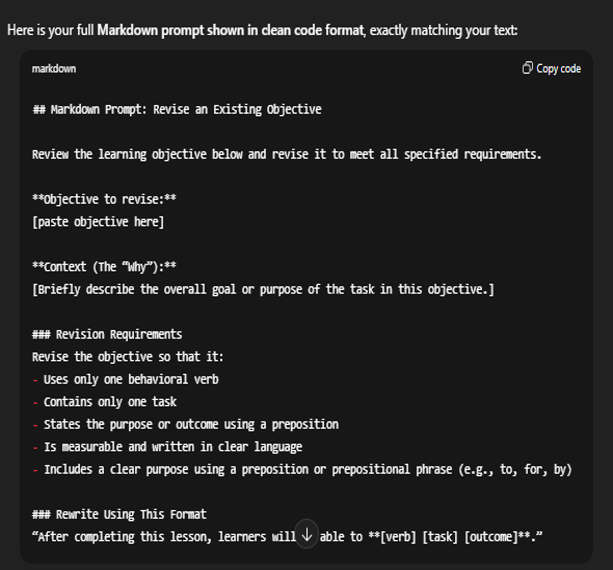
Prompt 2 — Revise an Existing Objective (Single Verb / Single Task)
Review the learning objective below and revise it to meet all specified requirements.

Objective to revise:
[paste objective here]

Context (The “Why”):
[briefly describe the overall goal or purpose of the task in this objective]

Revise the objective so that it:
• Uses only one behavioral verb
• Contains only one task
• States the purpose/outcome using a preposition or prepositional phrase (to, for, by)
• Is measurable and written in clear language

Rewrite using this format:
“After completing this lesson, learners will be able to [verb] [task] [outcome].”
Prompt 3 — Create a Knowledge Check from an ELO
Create a knowledge check aligned to the enabling learning objective below.

ELO:
[paste enabling learning objective here]

Requirements:
• Align the question to the Bloom’s level implied by the verb in the ELO.
• Use one of the following formats: multiple choice, matching, or scenario-based.
• Provide the correct answer and a brief rationale.
• Keep wording clear, concise, and unambiguous.

Editorial Review & Quality Assurance
A QA approach that strengthens clarity, consistency, accuracy, and instructional alignment across deliverables.
Contact
I welcome opportunities to support teams seeking clarity, consistency, and instructional rigor. Please feel free to reach out to discuss potential collaboration.
- Email: ejmoorellc@gmail.com
- LinkedIn: linkedin.com/in/evelyn-moore-6501ba363
- Location: Available for remote work